
For decades, family law practices ran on referrals. A satisfied client told a friend, a local accountant sent a case your way, and the calendar stayed full. That model still matters, but it is no longer enough on its own. The person going through a divorce or custody dispute today does not ask a friend first. They open Google at midnight, type their worry into the search bar, and start reading. The firm that shows up in that moment, with clear answers and an easy way to make contact, is the firm that earns the case.
This shift has changed what it takes to grow a family law practice. Getting more clients online is no longer optional or advanced. It is the core of modern family law marketing. The encouraging part is that the process is not mysterious. It comes down to a handful of channels working together, plus one thing most firms get wrong. This guide walks through the entire playbook, from how clients search to how you turn a nervous reader into a signed client.
Understand How Family Law Clients Actually Search
Everything starts with search behavior, because if you do not understand how clients look for help, every other tactic misfires. Someone dealing with a family law matter rarely searches in legal terms. They search in plain, emotional language. They type things like “who gets custody if we were never married,” “how much does a divorce cost,” or simply “divorce lawyer near me.”
These queries fall into two broad groups, and understanding the difference shapes your whole strategy. Research searches happen early. The person is scared, confused, and trying to understand their situation before they commit to anything. Hire-me searches happen later, once they have decided they need a professional and are ready to pick one. A complete online presence captures both. It educates the researcher, builds trust over days or weeks, and is right there when they finally decide to act.
Family law also carries a strong local signal. A person in Calgary needs a Calgary lawyer, not a national brand. That local intent is why so much of what follows focuses on being visible in a specific geographic area rather than trying to rank everywhere.
The Core Channels That Bring in Family Law Clients
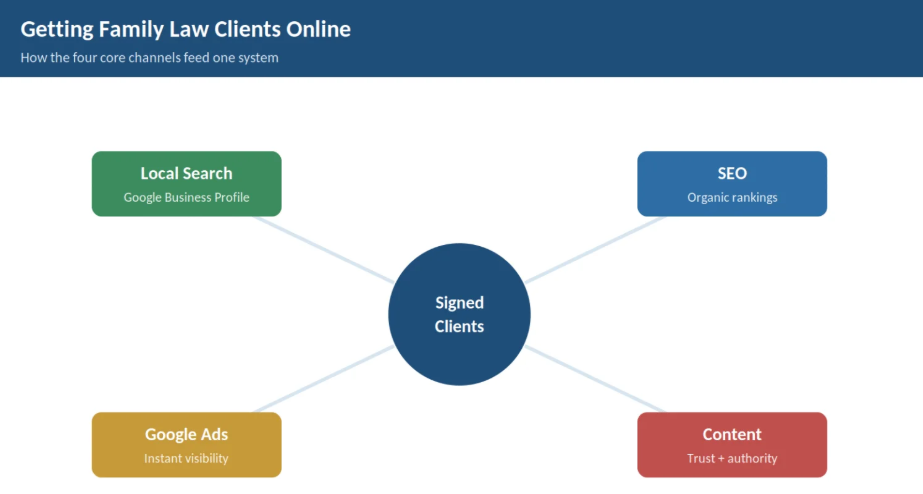
Think of online client acquisition as a set of channels that feed each other. No single one wins alone. Here are the four that matter most for a family law practice, and how each contributes.
1. Local search and your Google Business Profile
When someone searches for a family lawyer, Google shows a map with three local listings above everything else. This block, often called the map pack, is prime real estate. Landing in it frequently matters more than ranking first in the regular results below.
Your Google Business Profile is the free listing that controls this. Claiming it, completing every field, choosing accurate categories, adding real photos, and keeping your hours and service area current is the single highest-return activity for most local firms. Pair that with a steady flow of genuine client reviews and consistent contact details across the web, and you have built the foundation of local visibility.
2. A website built to convert, not just to look good
Traffic is worthless if the site does nothing with it. Many firms invest in a beautiful design that quietly loses business because it buries the phone number, loads slowly, or fails to answer the visitor’s real questions. A website that actually converts has fast load times, a clear page for each practice area, visible contact options on every screen, and trust signals like attorney bios, credentials, and reviews.
Think of your site as your best associate working around the clock. When it explains your services clearly and makes reaching out effortless, it turns anonymous visitors into booked consultations. When it does not, every dollar you spend driving traffic leaks straight out the bottom.
3. Search engine optimization for durable, non-paid traffic
SEO is the work that earns you steady, unpaid visibility over time. It includes optimized practice-area pages, helpful blog content that answers client questions, and local landing pages for the areas you serve. Unlike ads, SEO does not stop the moment you stop spending. The rankings you build keep delivering traffic month after month, which is why it becomes the most cost-effective client source a firm can develop.
The trade-off is patience. Family law SEO usually takes three to six months to gain real traction, then compounds. Firms that start early and stay consistent build an asset that competitors find hard to displace.
4. Paid advertising for cases you need right now
Google Ads and Local Services Ads put your firm at the top of the results immediately. They cost money per click or per lead, and legal keywords are among the most expensive anywhere, but for a practice that needs cases this month, paid search fills the pipeline while the slower channels build. Used well, ads and SEO cover each other’s weaknesses: ads bring speed, SEO brings staying power.
The System Beats the Tactics
Here is where most family law firms go wrong. They treat these channels as separate side projects. They run a few ads one month, dabble in a blog post the next, then forget the Google profile entirely. Each piece works in isolation, so none of it compounds.
The firms that grow treat online marketing as one connected system. The blog content targets the keywords the ads also bid on. The Google profile drives reviews that make both the ads and the organic listings more clickable. The website converts traffic from every source. When the channels reinforce each other, the whole becomes far greater than the sum of its parts.
Building and running that system takes time and expertise that most attorneys simply do not have between court dates and client work. This is why a growing number of practices partner with a team that offers dedicated family law firm services covering local search, SEO, paid ads, content, and lead generation under one roof. The marketing runs as a coordinated engine while the lawyers focus on practicing law.
Intake: The Channel Everyone Forgets
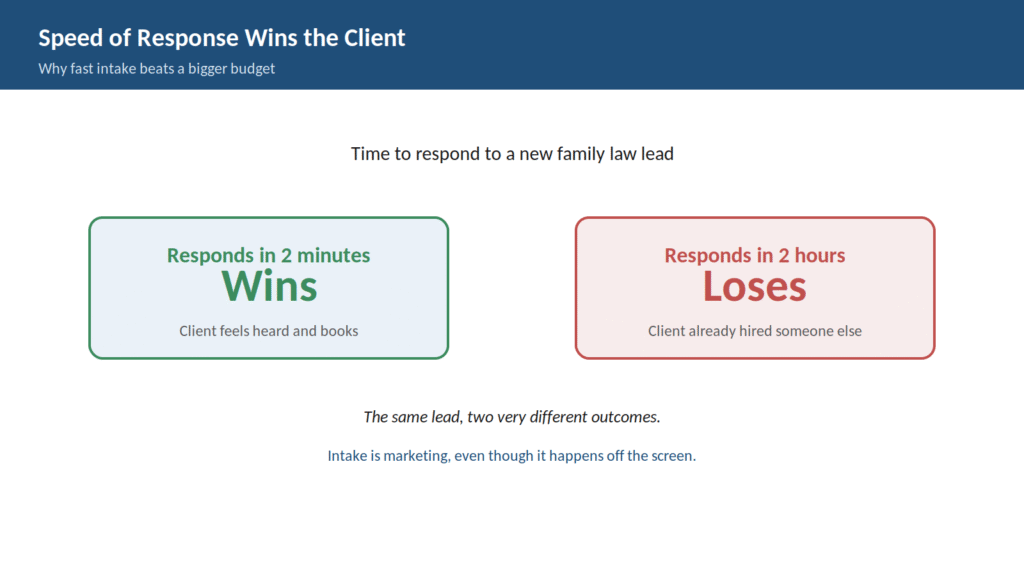
You can do everything above perfectly and still lose the client, because the case is often won or lost after the click. Intake is the quiet failure point in family law marketing. A lead that waits two hours for a callback usually hires the firm that answered in two minutes.
Family law clients are anxious and ready to act. When they reach out, they want a human, fast. That means answering the phone live during business hours, responding to form submissions within minutes, and having a warm, organized process for booking the consultation. A firm with mediocre marketing and excellent intake will often out-earn a firm with the reverse. Speed and empathy at the point of contact are marketing, even though they happen off the screen.
A Step-by-Step Starting Plan
If you are building this from scratch, sequence matters. Here is a sensible order that delivers early wins while laying the foundation for long-term growth.
- Claim and fully optimize your Google Business Profile, then start requesting reviews.
- Audit your website for speed, clarity, and visible contact options, and fix the biggest gaps.
- Build a dedicated page for each core practice area you offer.
- Launch a focused Google Ads campaign on your highest-intent keywords to bring in cases now.
- Begin publishing helpful, question-based content to grow organic traffic over time.
- Set up call tracking so you know which channels actually produce signed clients.
Actionable Tips for Faster Results
- Ask every satisfied client for a review. Reviews lift local rankings and directly influence whether prospects call.
- Create one page per practice area. A dedicated custody page ranks far better than a single catch-all services list.
- Respond in minutes, not hours. The fastest firm usually signs the client, regardless of who has the bigger budget.
- Track your lead sources. Without call tracking, you are guessing about what works and wasting spend on what does not.
- Keep contact details identical everywhere. Inconsistent name, address, and phone data across the web quietly drags down local visibility.
Common Mistakes to Avoid
- Treating channels as one-off projects instead of a connected system that compounds.
- Neglecting intake so hard-won leads slip away before anyone follows up.
- Chasing every new tactic before the fundamentals are working.
- Ignoring mobile, even though most family law searches happen on phones with intent to call.
Building Trust Before the First Call
In family law, trust is the currency that decides everything. A prospective client is about to share the most private, painful details of their life with a stranger. Before they do, they need to feel that your firm is competent, discreet, and genuinely on their side. Your online presence is where that trust is either built or lost, long before anyone picks up the phone.
Several elements work together to establish this trust. Detailed attorney biographies that highlight experience and credentials reassure clients they are dealing with a real expert. Genuine client reviews provide social proof from people who were once in the same frightening position. Case results, where ethics rules permit, demonstrate a track record. Even professional photography and a clean, modern website signal that your firm is established and serious. Each of these quietly answers the question every client is really asking: can I trust these people with my family?
Educational content plays a huge role here too. When your website patiently explains what a client can expect, without pressure or legalese, it demonstrates empathy and expertise at the same time. A firm that teaches freely comes across as confident and client-focused, which is exactly the impression that turns a hesitant browser into a booked consultation.
Measuring What Actually Matters
Many firms invest in marketing without ever knowing what works. They see some new clients, assume the marketing must be doing its job, and never dig deeper. This is a costly mistake, because without measurement you cannot double down on what performs or cut what wastes money.
Start by tracking leads at the source. Call tracking numbers reveal which channel produced each phone call. Form analytics show which pages generate inquiries. Then look past surface metrics. Website traffic feels good but means little on its own. What matters is the number of qualified consultations booked and, ultimately, the cost per signed client from each channel. A campaign that brings a flood of traffic but no cases is failing, while a quiet channel that consistently produces signed clients is gold.
Review these numbers monthly. Over time, a clear picture emerges of where your best clients come from, and you can shift budget and effort toward the channels that genuinely grow your practice. This discipline separates firms that scale predictably from those that spend and hope.
Frequently Asked Questions
How long does it take to get more family law clients online?
Paid ads can produce leads within days. SEO and local optimization usually take three to six months to build momentum, then keep growing. Most firms run both so they get quick wins while the long-term traffic develops.
Do small family law firms really need a website?
Yes. Even referral clients look you up before calling, so a weak or missing site quietly loses business you never knew existed. A clear, fast site that makes contact easy is essential.
What is the cheapest way to start?
Optimizing your Google Business Profile and gathering genuine reviews costs nothing but time and delivers strong local visibility. It is the best first move for a firm on a limited budget.
Should I hire an agency or do this in-house?
Small firms often start with the basics themselves, then bring in specialized help once they see the potential and want to scale. Running a family law firm is competitive and expensive enough that expert help usually pays for itself.
How do I know if my marketing is working?
Track leads by source with call tracking and form analytics, and watch cost per signed client rather than vanity metrics like traffic alone. Real success is measured in cases, not clicks.
Conclusion
Getting more family law clients online is not about chasing trends or spreading yourself across every platform. It is about showing up when people search, earning their trust with clear and helpful information, and making it effortless to reach you, then responding fast when they do. Build local visibility, a website that converts, organic content, and paid ads into one connected system, and support all of it with quick, human intake.
Do that well, and something powerful happens: referrals stop being your entire business and become the bonus on top of a steady, predictable stream of new clients. That is the difference between a practice that depends on word of mouth and one that grows on its own terms.
For firms that want this whole system built and run for them, Law Firm SEO offers dedicated SEO and growth support built specifically for legal practices.