
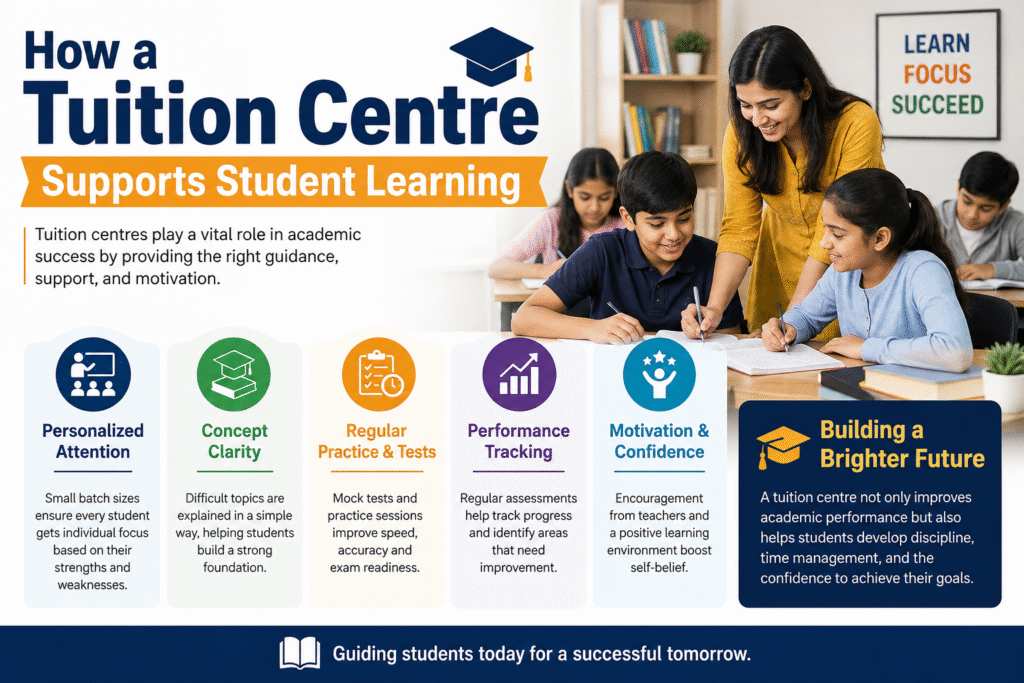
Schools provide students with the essential academic foundation they need, but meaningful learning does not always stop when the school day ends. Students may require additional opportunities to clarify difficult concepts, practise unfamiliar question types, strengthen weak areas, and develop greater confidence in their abilities. Supplementary education can play a useful role when it complements classroom learning rather than simply adding more workload.
Choosing the right tuition centre can therefore influence more than examination preparation. A well-structured learning environment can help students develop stronger study habits, critical-thinking abilities, communication skills, and greater independence. These qualities are particularly valuable within Singapore’s education system, where students gradually encounter more demanding syllabuses and increasingly complex forms of assessment. For parents, the key is to identify a tuition provider that focuses on meaningful development rather than short-term results alone. The most effective support should help students understand what they are learning and eventually become more capable of managing their own academic progress.
What Learning Beyond the Classroom Really Means
Learning beyond the classroom is not simply about studying for additional hours. It involves encouraging students to apply knowledge, explore ideas, and develop skills that may not always be fully developed during regular lessons.
A student who learns effectively outside school may become better at:
- Applying concepts to unfamiliar questions
- Identifying personal learning gaps
- Asking thoughtful questions
- Reviewing mistakes independently
- Managing revision time
- Connecting academic ideas with real-life situations
These abilities can support students across subjects and remain useful as they progress towards higher levels of education.
Strengthening Understanding Instead of Relying on Memorisation
Memorisation can help students remember facts, formulas, and definitions, but long-term academic progress requires deeper understanding. Students need to know how information connects and how it can be applied in different contexts.
For example, a student may memorise a mathematical formula but still struggle when a question presents the information in an unfamiliar way. Similarly, a science student may remember a definition without being able to explain how the concept works in a practical situation.
An effective tuition programme encourages students to understand the reasoning behind what they learn. Tutors can use examples, questioning techniques, diagrams, and guided exercises to move students from simple recall towards application and analysis.
From Memorisation to Meaningful Learning
| Basic Learning Approach | Deeper Learning Approach |
| Memorising facts | Understanding relationships between concepts |
| Repeating model answers | Applying knowledge to new questions |
| Correcting mistakes | Understanding the reason behind mistakes |
| Completing worksheets | Reflecting on learning outcomes |
| Following instructions | Developing independent strategies |
This approach can make students more adaptable when they encounter unfamiliar academic challenges.
Providing Personalised Academic Support
Every student has a different learning profile. Some learners may understand concepts quickly but struggle with writing, while others may need more time to develop foundational knowledge before moving to advanced material.
A good tuition centre should provide opportunities to identify and address these differences.
Personalised support can include:
- Revisiting difficult concepts
- Providing targeted exercises
- Adjusting question difficulty
- Giving individual feedback
- Identifying recurring mistakes
- Suggesting suitable revision techniques
This ensures that students are not simply moving through the same material at the same pace without addressing their individual needs.
Building Confidence Through Consistent Practice
Academic confidence often develops through repeated experiences of improvement. When students regularly struggle without understanding how to improve, they may become reluctant to participate or attempt difficult questions.
A supportive tuition environment can change this experience by allowing students to practise progressively challenging tasks while receiving guidance.
Students can benefit from:
- Asking questions in a supportive environment
- Attempting challenging problems without fear of failure
- Receiving immediate clarification
- Reviewing mistakes constructively
- Seeing measurable improvement over time
As students become more familiar with challenging material, they may approach schoolwork with greater confidence and willingness to participate.
Developing Independent Learning Habits
One of the most valuable roles of supplementary education is teaching students how to learn independently.
As academic expectations increase, students cannot rely entirely on teachers or tutors to explain every concept. They need to recognise their own weaknesses, organise their revision, and evaluate their progress.
Important Independent Learning Skills
- Planning realistic study schedules
- Taking effective notes
- Reviewing mistakes
- Setting academic goals
- Prioritising weaker topics
- Checking answers carefully
- Seeking clarification when necessary
A good tutor should gradually encourage students to take greater responsibility for these activities rather than creating dependence on tuition.
Encouraging Critical Thinking and Problem-Solving
Singapore students are expected to apply knowledge rather than simply reproduce memorised information. This makes critical thinking and problem-solving increasingly important as they progress through their education.
A tuition programme can encourage these abilities through discussion, open-ended questions, practical examples, and unfamiliar problem scenarios.
Instead of simply asking students to identify an answer, tutors can encourage them to explain:
- Why their answer is appropriate
- Which evidence supports their conclusion
- What alternative approaches could be considered
- How the result might change under different conditions
Such activities develop reasoning skills that are useful across academic subjects.
Connecting Academic Knowledge with Real Life
Students are often more engaged when they understand how classroom concepts relate to the world around them.
A well-designed tuition lesson can use everyday examples to make academic ideas more relevant. Mathematics can be connected to budgeting and measurement, science to health and environmental issues, and English to communication and current affairs.
This approach helps students recognise that education is not simply about passing examinations. Academic knowledge can also help them understand and navigate everyday situations.
Creating a Positive Learning Environment
The atmosphere in which students learn can influence their motivation and willingness to participate.
A positive tuition environment should allow students to make mistakes without feeling embarrassed. Constructive correction helps learners understand that mistakes are part of the learning process rather than evidence of failure.
An effective learning environment generally encourages:
- Respectful communication
- Active participation
- Curiosity
- Questioning
- Constructive feedback
- Consistent effort
When students feel comfortable seeking clarification, they are more likely to address learning gaps before those gaps become more difficult to overcome.
Supporting Better Time Management
Adding tuition to a student’s schedule requires careful planning. Students already have schoolwork, homework, co-curricular activities, revision, and personal commitments.
The right tuition centre should support learning without creating an unsustainable timetable.
Parents should consider whether:
- Lesson frequency is manageable
- Homework demands are reasonable
- Students have enough independent study time
- Tuition fits around school commitments
- There is sufficient time for rest and recreation
A balanced schedule can make academic support more sustainable and reduce unnecessary pressure.
The Role of Experienced Educational Guidance
Experienced educators can provide valuable insight into common learning difficulties and effective study approaches. However, parents should look beyond reputation alone and consider how a centre actually supports students.
Established education providers such as Mavis Tutorial Centre can offer structured learning environments where students receive additional academic guidance and opportunities for focused practice. The most important consideration is whether the teaching approach, resources, class structure, and feedback system align with the student’s individual requirements.
Good educational guidance should ultimately encourage students to become more confident and self-directed learners.
How Parents Can Evaluate a Tuition Centre
Before enrolling a child, parents can consider several practical factors.
Key Areas to Assess
- Teaching quality: Are tutors able to explain difficult concepts clearly?
- Class size: Will students receive enough individual attention?
- Learning resources: Are materials relevant and appropriately challenging?
- Progress monitoring: Is student development assessed regularly?
- Lesson structure: Are sessions interactive and purposeful?
- Student well-being: Is the workload manageable?
- Communication: Does the centre provide useful feedback to parents?
Considering these factors can help families choose educational support based on genuine learning needs rather than promotional claims.
Final Thoughts
The right tuition centre can support students in ways that extend well beyond additional worksheets and examination practice. By strengthening understanding, encouraging critical thinking, building confidence, and developing independent study habits, effective tuition can complement classroom education and prepare students for future academic demands.
For students in Singapore, this broader approach can be particularly valuable as they progress through increasingly challenging stages of education. The goal should not simply be to improve the next test result but to develop learners who can think independently, solve problems confidently, and take greater ownership of their education. Parents seeking structured academic support can explore educational programmes and resources at mavistutorial.com to help students strengthen their foundations, develop effective learning habits, and make steady progress throughout their academic journey.
Frequently Asked Questions
1. What should a tuition centre provide beyond school lessons?
A good tuition centre should provide opportunities for students to clarify difficult concepts, practise application-based questions, and receive personalised feedback. These activities can reinforce what students learn at school. It should also help learners develop study strategies, critical-thinking skills, and greater confidence so they can gradually become more independent.
2. Can tuition help students become better independent learners?
Yes. Effective tuition should teach students how to identify weaknesses, organise revision, analyse mistakes, and approach difficult questions systematically. The long-term objective should be to give students useful strategies they can eventually apply without constant guidance from a tutor.
3. Is tuition suitable for students who are already doing well?
Tuition can benefit stronger students when it provides opportunities to explore challenging questions and develop greater analytical skills. It can also help them refine examination techniques and address smaller weaknesses before they become significant. However, the programme should remain appropriately challenging and avoid unnecessary repetition of material the student has already mastered.
4. How can parents determine whether a tuition centre is effective?
Parents can monitor changes in their child’s understanding, confidence, study habits, and ability to complete work independently. Academic results can provide useful information, but they should not be the only measure of progress. Regular communication with tutors can also help parents understand which areas have improved and where further support may be required.
5. How should students balance tuition with school and other activities?
Students need a manageable schedule that includes schoolwork, tuition, independent revision, co-curricular activities, rest, and personal time. Excessive academic commitments can reduce concentration and motivation. Parents should therefore consider lesson frequency and workload carefully, choosing a programme that supports consistent learning without overwhelming the student.