
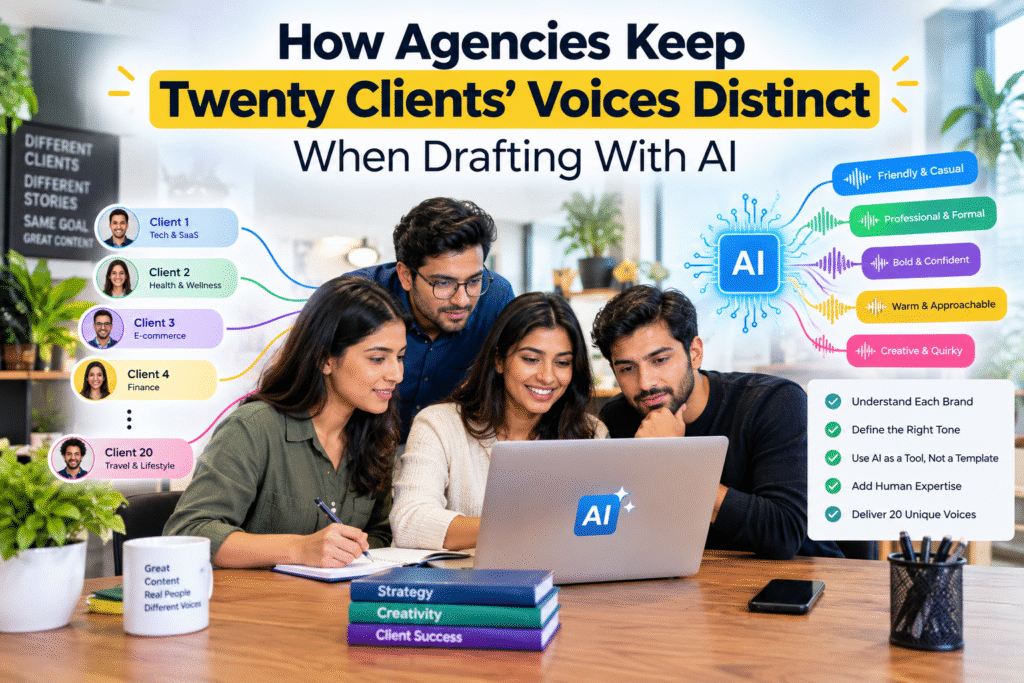
An agency writing for twenty clients has twenty brand voices to protect and roughly the same drafting tools as everyone else. Left alone, those tools pull every client toward the same smooth, agreeable middle.
The clients can usually feel it before they can explain it. A founder reads a draft and says it sounds fine but not like them, and the account manager is left trying to translate that into an edit.
Why Agencies Feel the Problem First
An in-house team writes in one voice and learns it over time. An agency switches voices dozens of times a week, often with the same writer moving between a playful consumer brand and a cautious financial one before lunch. Any shortcut that flattens differences hits an agency’s core product directly.
The CoSchedule survey of 1,005 marketing professionals found that 85 percent now use AI writing tools, so the shortcut is available to every competitor. What separates agencies is the review that happens after the draft exists.
The Hidden Cost of Revision Rounds
Each time a client sends back a draft because it does not sound like them, the agency absorbs the cost of the extra round. Multiply that by twenty clients and a few drafts a week, and the lost hours exceed whatever drafting speed was gained.
The Lucidpress survey of more than 400 brand experts found that 81 percent of organizations still deal with off-brand content despite written guidelines. Guidelines describe a voice. They do not stop a drafting tool from sanding it down.
What a Voice Sheet Should Contain
- Three real sentences the client has written, not described, so tone can be matched rather than guessed.
- Words and constructions the client never uses, which are often the clearest signal of generic drafting.
- Typical sentence length and how often the client uses fragments or questions.
- Topics where the client has a strong, specific opinion that a generic draft would soften.
Building a Repeatable Review Step
The pattern that scales is a fixed checkpoint between draft and client delivery. A writer reads the draft against the voice sheet, adds at least one detail only that client could supply, and checks that the rhythm resembles the sample sentences rather than the tool’s default.
When rhythm is the main gap, it can help to humanize AI text in a lighter mode and compare the two versions against the sample sentences. The comparison itself teaches the team which settings suit which client.
Accounts that need a heavier touch, such as a lively consumer brand, can use a stronger setting. Accounts with a formal voice usually need only a light adjustment to sentence length and word choice.
Training Writers, Not Just Tools
Junior writers often accept the first plausible draft because it reads cleanly. Showing them side-by-side examples of a generic draft and a voice-matched one builds the judgment that no tool provides. Over a few months, the team’s first drafts improve and the review step gets faster.
It also pays to keep a short file of past client edits. Patterns emerge quickly: a client who always cuts the closing summary sentence, or always replaces a formal verb with a casual one. Feeding those preferences into the next draft saves a round.
Reporting the Value to Clients
Clients rarely ask how a draft was produced, but they do notice consistency across a quarter of content. Agencies that can point to a documented voice process tend to keep accounts longer, because the voice stays stable even when the writer changes.
Handling the Account That Insists on Speed
Some clients prioritize turnaround above everything and push for same-day delivery. Agencies can accommodate that without abandoning quality by deciding in advance which accounts get which level of review. A fast-turn account might receive the light rhythm check and one personal detail, while a flagship account receives the full voice review.
Being explicit with the client about the trade-off helps. Most will happily accept a day’s delay on the pieces that carry the most visibility, as long as the faster pieces still sound like them.
Common Failure Patterns Across Accounts
- Every client’s blog opens with a question and closes with a call to action in the same shape.
- Subject lines and headlines drift toward the same handful of power words.
- Case studies read as templates with the client’s name swapped in.
- Social captions use the same enthusiasm level whether the brand is playful or serious.
Spotting these across accounts is easier for an agency than for a single in-house team, because the agency sees the same drift in many places at once. That perspective is an asset worth using.
Documenting the Process for Onboarding
New writers are the most vulnerable to generic drafting, because they have not yet absorbed any client’s voice. A short onboarding document that describes the review steps, shows before-and-after examples, and lists each client’s voice sheet shortens the learning curve considerably.
It also gives account managers a shared language for feedback. Instead of saying a draft feels off, they can point to a specific item, such as sentence length being too even or the opening matching the generic pattern.
What to Show Clients About Your Process
Clients value predictability. A one-page description of how drafts are produced and reviewed reassures them without exposing proprietary detail. It can state that drafts begin with assisted structuring, that every claim is verified by a writer, and that a voice review happens before delivery.
The description also sets expectations about what the agency will not do, such as publishing unreviewed drafts or inventing statistics. Those commitments cost nothing to keep and build trust over time.
Scaling the Review as the Roster Grows
A process that works for five clients may break at twenty. As the roster grows, the voice sheets multiply and so does the chance of mixing them up. Agencies handle this by assigning a voice owner for each account, a single writer who reads every piece before delivery and who knows the client’s preferences deeply.
Pairing each voice owner with a backup avoids a single point of failure, and rotating backups periodically spreads knowledge across the team. The result is a quality floor that does not depend on any one person being available.
Learning From Lost Accounts
When a client leaves, the reason is rarely stated as a voice problem. It is usually described as the content not feeling right or not sounding like us. Reviewing lost accounts with that lens often shows a pattern of drift that nobody flagged until it was too late. Agencies that run this kind of review once a year tend to tighten their process considerably.
The same review can be done for accounts that stayed. Asking what the client appreciates most frequently reveals that consistency of voice sits near the top, even when it is not on the formal list of services.
AI drafting is now a baseline for agencies, not a differentiator. The differentiator is the discipline of protecting each client’s voice after the draft exists, with a documented sheet, a fixed review step, and a quick rhythm adjustment where it is needed.